

Bliss Towers, Now
Condition, governance, and the responsibility of getting this right

This is Part Two in a series about Bliss Towers in Hudson, NY. In Part One, I wrote about memory. About the first night a nine-year-old boy and his mother slept in Bliss Towers. About what the building meant when it opened, and the history that shaped it.
This piece turns to the present: the condition of the building today, the redevelopment proposal now before the Planning Board, and the decisions Hudson must make about what comes next.
Bliss Towers today is not the building that child first stepped into in 1973. It is a structure that has carried five decades of use without being properly maintained or fully renewed. It has absorbed thousands of lives, weather, patchwork repairs, and the slow erosion that comes when systems age faster than funding arrives to update them.
A few months ago, I toured the building with former mayor Kamal Johnson and mayoral aide Justin Weaver. We were guided by Mike, the building manager. When we met Mike outside, he was friendly but somber; it was clear he took the task of showing the mayor Bliss’ current condition seriously.
We walked past a security guard and into the elevator. Mike watched for our reaction when it started going up. The elevator scraped as it moved, metal brushing against the shaft in a way you could feel through your feet.
When the doors opened, I hesitated before stepping out. The floor wasn’t level. There was a brief, disorienting sense of vertigo.
The hallway was long, narrow, and fluorescent-lit. The floors bore the marks of decades of wear. In some places, the beams beneath were raised slightly while the surrounding floor had settled around them, creating shallow ridges you could feel as you walked. The walls had been patched and re-patched over the years, the repairs visible beneath layers of paint.


Mike pointed to areas where water had found its way through ceilings and walls. In one unit we visited, the ceiling had opened along a seam and the plaster had peeled back, leaving a long scar where water had run down the wall. Elsewhere, maintenance panels and small holes told the story of repeated attempts to reach aging pipes and wiring.
Mike explained the building’s most serious challenge: asbestos. It lies dormant in the walls, floor tiles, and popcorn ceilings — until they are disrupted in any way. Every time a hole is discovered, asbestos remediation is required. But the cost of remediation often exceeds the value of the unit itself. Instead of repairing the damage, the unit is taken offline.
At the time of my tour, the numbers were staggering: only 84 of 135 units were occupied. The rest were unlivable — they couldn’t be repaired safely or affordably.
Outside, the signs of age were evident too. The playground beside the building was small and worn. Pieces of the play structure had broken off over time. The bridge had recently been repaired, the fresh pine standing out in contrast to the rest of the structure. The basketball court nearby slanted slightly downhill, its asphalt split by long cracks. And yet the space carries the marks of the generations of children who have played there.
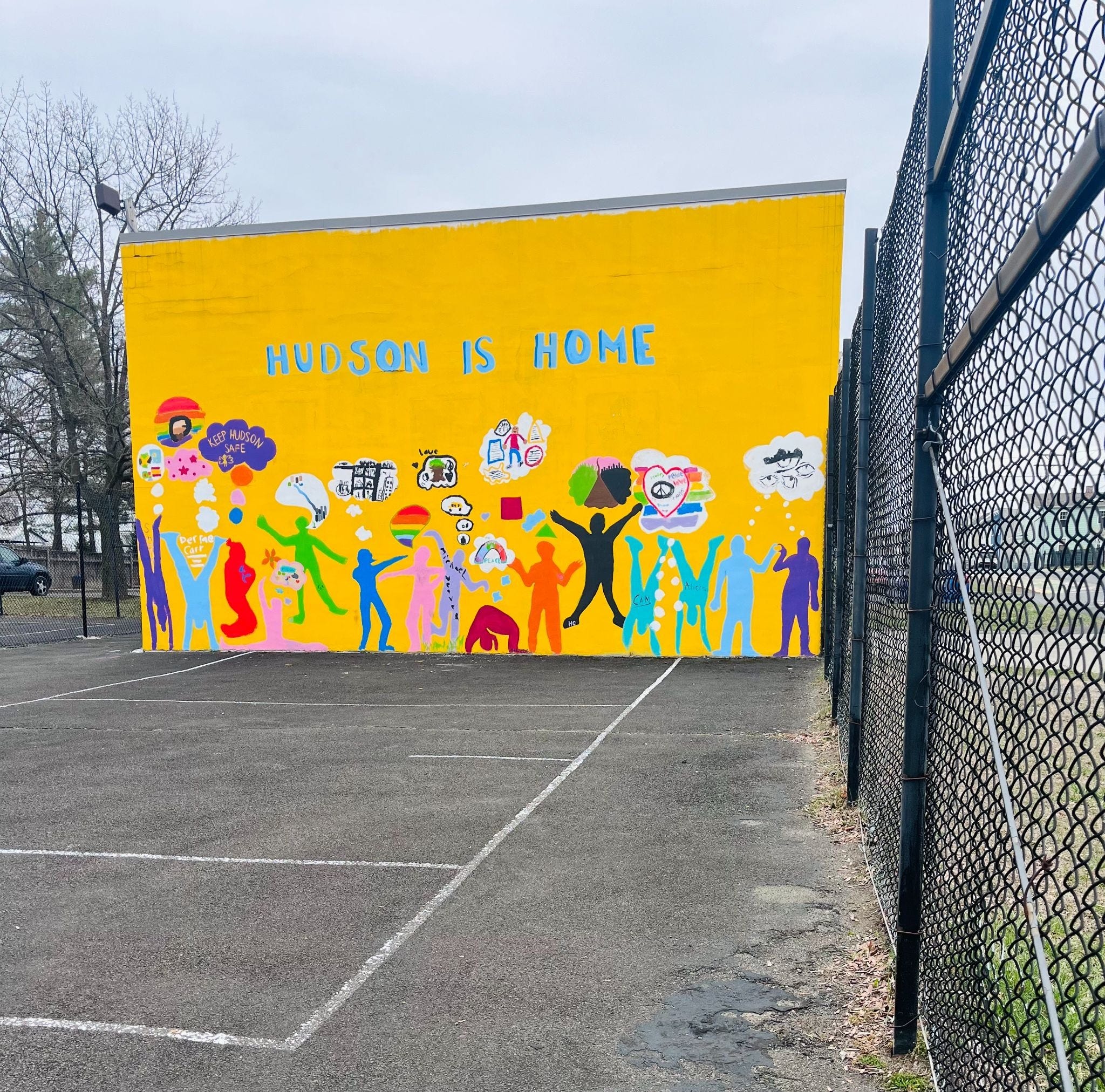
Directly adjacent to the court, painted on a bright yellow wall, a mural reads: “HUDSON IS HOME.” Bright silhouettes of people stretch across the wall — children, neighbors, families — a reminder that even inside a building under strain, a community has continued to grow.
For me, seeing the building up close was clarifying. But none of what Mike showed us was new information.
The condition of Bliss Towers has been discussed publicly for years. Residents have testified about it at Common Council meetings. Housing Authority officials have described the same structural challenges in reports and public presentations. Local news coverage has returned to the issue again and again: aging systems, asbestos constraints, and a building whose repairs have become increasingly difficult to justify.
The question of what to do about Bliss has not appeared suddenly. For several years — through changing administrations, complex state requirements, engineering reviews, and narrow funding windows — the Hudson Housing Authority (HHA) has been preparing for a full redevelopment of Bliss Towers and the adjacent Columbia Apartments. The idea has been on the table since at least 2021, when the HHA issued a Request for Qualifications to identify a development partner to help redesign and rebuild the city’s public housing stock.
And now that proposal has been formally presented to the Planning Board, the group tasked with reviewing the project’s environmental impacts, site plan, and design before construction can move forward. Hudson’s Planning Board is composed of seven members appointed by the mayor and confirmed by the Common Council. Three of the current members were appointed recently by Mayor Joe Ferris after he took office, meaning the redevelopment of Bliss Towers is now being considered by a newly constituted board.
That board assessed the Bliss redevelopment proposal at a February 10th Planning Board Meeting, presented by the HHA. HHA chair Revonda Smith began the meeting by sharing her personal experience. She described growing up in Hudson’s public housing, and noted that her parents still live there. Her remarks grounded the discussion in what public housing in Hudson has meant — home across generations.
Alongside her, Jeffrey Dodson, HHA Executive Director, was direct about the building’s condition. Elevators, wiring, plumbing, and facade systems date back to 1973 and have never undergone full modernization.
Fifty years is not, on its own, an especially long life for a building. Many last much longer. But buildings require periodic reinvestment in their core systems to remain safe and functional. At Bliss Towers, those systems have aged in place.
That story is not unique to Hudson. Public housing authorities across the country are grappling with decades of deferred maintenance — with national estimates placing the backlog of needed repairs at roughly $70 billion. Bliss Towers is officially considered obsolete, and incremental repairs are no longer keeping pace with the building’s decline.
But statistics and engineering assessments only tell part of the story. The people who understand the building most intimately are the people who live there — and the Housing Authority staff who work with them every day.
That day-to-day relationship has also shaped the redevelopment proposal itself, which has been informed by residents’ experiences living in an aging building. And for some residents, the pace of the process can be difficult to reconcile with the conditions they face every day.
That tension — between careful process and the urgency of lived conditions — has surfaced repeatedly over the past several years. I think back to a Common Council meeting I attended in May of 2024. Several residents spoke that night, but one comment in particular has stayed with me.
Ifetayo Cobbins, a resident of Bliss Towers, stood up and spoke plainly: “We live in Bliss Towers. You all don’t. The building’s about to fall down… we live there with the half broken down elevators… a tilted building… water draining from the roofs… and you all are saying wait.”
She was emotional and resolute. Her words precise in what they conveyed: exhaustion. Exhaustion with hearings. With process. With delay. From inside the building, urgency does not feel theoretical. It feels structural. It feels like riding an elevator that may or may not work. Like living in a space that shifts beneath you. It is possible to value careful review and still hear what residents are saying when they insist that waiting has costs.
Not every resident expresses that urgency in the same way, but many describe the same underlying reality: Bliss Towers has reached a difficult point.
Larry Decker has lived in Bliss Towers since 1997. When he first moved in, he remembers a stronger sense of neighborliness in the building. “Everybody pretty much got along and looked out for each other,” he told me. Neighbors helped one another with childcare, shared food, and kept an eye out for each other’s families.
Today, he says, the atmosphere feels more strained. But when it comes to the question of redevelopment, his view is straightforward. “I’m all for it,” he said. “This building is falling apart and maintenance is having a hard time keeping it going.”
Larry also shared that residents have already had opportunities to weigh in. “Mountco was there asking tenants for some of their ideas,” he said of an earlier meeting with the development team, Mountco. “Most of them, I believe, have been considered.”
For others, the story of Bliss stretches even further back.
Glenda Lee first lived in Bliss as a teenager. She moved out at 18, later bought a home in 2003, and eventually returned to the building in 2013. Like longtime resident Tyrone Hedgepeth, her family was among the early residents when the towers first opened, and some of her relatives still live there today.
Growing up in the building, she remembers a stronger sense of community. “Back then, it was more loving,” she told me. “We all looked out for each other.”
Her life eventually took her elsewhere. But in time, she found herself returning. When she returned, the differences were noticeable. She said the building felt less cared for than it once had. And yet returning also gave her a new perspective on the place itself.
“I’ve lived in luxury, and I’ve lived here,” she said. “Life brought me right back to where I came from. It makes me appreciate the building.”
But along with that appreciation comes skepticism; she is skeptical that redevelopment will actually happen.
“I hope to see it rebuilt in my time, but I don’t think so,” she told me. “They keep stalling and stalling, letting the building fall down around us.”
For residents like Larry and Glenda, the question is not whether something should be done about Bliss Towers. The question is how it will happen — and what the future of the place they have known for decades will look like.
The current plan for the redevelopment is deliberately phased.
Phase One focuses on building new housing on underused portions of the site — including two four-story buildings (known as A1 and B1) and four townhouses adjacent to and across the street from Bliss Towers — before any demolition happens. The idea is that residents can move directly into these new units on site, avoiding displacement during construction.
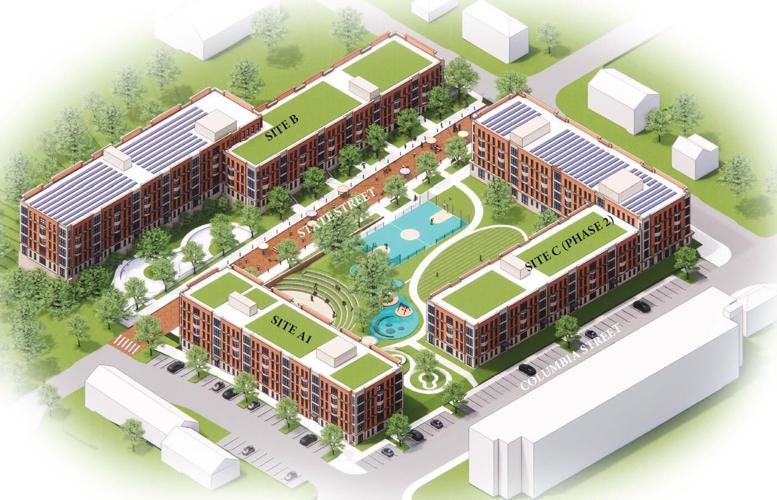
In total, the redevelopment would expand the number of units from the existing 135 to approximately 276 once both phases are completed. The first phase alone includes about 166 units, already exceeding the current total. Engineers have designed stormwater systems to accommodate the phased build, and traffic and parking analyses have been completed.
In addition to the expanded number of units, this proposal serves a broader range of incomes than public housing in Hudson currently does. While existing units at Bliss primarily serve households earning roughly 30 to 50% of Area Median Income, the additional units proposed in the redevelopment are expected to be affordable up to 50 to 80% of AMI.
In practical terms, that range includes people like childcare workers, teacher’s aides, grocery store workers, and other essential workers whose incomes are too high for traditional public housing, but far too low for Hudson’s private rental market. This housing is not solely functioning to replace units. It is also an attempt to address a widening gap between wages and rent.
Redevelopment of this size requires aligning funding within a narrow window. Dodson told the board that the project is slated for a state closing window in October 2026, and missing that window could delay the project by six to nine months or more, even as residents live with crumbling infrastructure.
Seven months may sound like ample time to close this deal. But a lot has to happen in that window. A newly constituted Planning Board is receiving a project years in the making, inheriting both its complexity and its urgency.
At the February meeting, Planning Board members acknowledged both realities. The building is deteriorating. Residents are living with the consequences. And yet the decisions being made now will shape housing in Hudson for generations.
Planning Board chair Ron Bogle spoke at length about how the board was approaching the project. While he emphasized the need to move the process forward, much of his comment focused on what kind of housing Hudson builds and what it signals.
“The history of affordable housing in our country is not always a great story,” he said. Early efforts in the mid-century, he argued, often produced “monstrous, institutional structures” that isolated residents rather than integrating them into the life of the city. “If you look at the Bliss Towers,” he said, “you can see that it carries the DNA of the early ’60s affordable housing movement.”
For Bogle, the opportunity before Hudson is to avoid repeating those mistakes. The best contemporary thinking in affordable housing, he said, emphasizes human scale, integration into existing neighborhoods, durable materials, and spaces that feel like homes rather than institutions.
He also framed the issue in moral terms. People living on low wages, he said, deserve places of dignity, pride, and belonging — places that are beautiful and thoughtfully designed.
The intention behind that sentiment was clear: affordability should not come at the expense of quality.
And yet, the comment landed uneasily. For some, the suggestion that residents may not be able to “see the beauty of the country around them” brushed up against a familiar issue in housing conversations. When we talk about dignity, beauty, and belonging, whose perspective are we describing — and what assumptions might we be making about the people those spaces are meant to serve?
Whatever the board’s guiding philosophy, the question is who gets to define what dignity looks like – and how it feels from the inside. That’s why I keep coming back to the people who live in Bliss.
For Larry Decker, what troubles him most is not the idea of rebuilding, but what he perceives from outside the building. “I know a lot of people who don’t live here don’t think we deserve a new building,” he said. “They would rather we just move away.”
Glenda Lee has felt that too. “Some people don’t want it rebuilt,” she said. “They don’t want us down there, period.”
Her response to this sentiment: “Where are the people supposed to go?”
That question echoes a tension that has surfaced repeatedly in Hudson’s housing conversations. For years, some have argued that large-scale public housing does not belong in the city at all — that it should be moved elsewhere, perhaps to neighboring Greenport, or replaced entirely by smaller scattered-site developments.
Others suggest that the market should simply be allowed to reshape the city, trusting that new housing will eventually emerge through private investment.
Some of those ideas have merit in theory. Smaller-scale housing integrated throughout neighborhoods can be an important part of a healthy housing system. But in a city the size of Hudson — just two square miles — that approach alone is unlikely to produce the number of homes the community direly needs.
The redevelopment proposal attempts to respond to both the building’s physical decline and the community that has grown inside it. The plan replaces Bliss with smaller buildings integrated into the surrounding neighborhood, and adds shared outdoor spaces.


In doing so, the project would significantly expand the existing housing, ultimately more than doubling the number of units available at the site. And that would have a clear and immediate impact: hundreds of people could live affordably in Hudson without displacing current residents during construction.
This is not the only housing strategy Hudson should pursue. We need homes at many scales and across many income levels. But this project offers something smaller developments do not: the ability to add hundreds of homes quickly during an acute housing crisis.
If Bliss Towers represented an earlier era of public housing — one defined by large institutional structures — the hope for the new development is something closer to a neighborhood: a place defined not just by buildings, but by the people who live there and the community they create.
And yet beneath all of these policy discussions lies a deeper question, one that the residents I spoke to all referenced. Does this community want public housing?
What kind of place does Hudson believe itself to be? A tourist destination? A weekend escape? A city where only people with wealth can afford to live? Or a city where people from many different walks of life can build stable lives?
Because public housing has always carried that weight. It houses people whose fortunes are often shaped by circumstances beyond their control — economic shifts, health challenges, family disruption, systemic inequality.
The question before Hudson now is not simply how to rebuild a structure. It is whether the city believes the people who live there belong here. Not just as residents in a building, but as neighbors, families, and part of the living history of the city itself.
The redevelopment of Bliss Towers will answer that question in ways that will shape Hudson for decades. What happens next will reveal how Hudson chooses to balance its past, the lives of the people who live here now, and the kind of city it hopes to become.
Love reading your articles, as a writer you get right into the heart of what you are writing about, so that the reader can feel and visualize the topic you are writing about. I remember when Bliss Towers was being built along with Schuyler Court, and Hudson Terrace Apartments. I believe Hudson Terrace was built during the time Urban Renewal happened to the City of Hudson. All houses near the river, and above were torn down. Residents who either owned homes or rented in these areas had to leave and “figure out where they were going to live”. Soon Hudson Terrace was built, next came the town houses on lower State Street, Schuyler Court, and Bliss Towers. All of these buildings were beautiful buildings, and maintained at the time. As years went by, Bliss Towers seemed to be the forgotten building, it was as if whoever was managing it gave up on the building. Over the years of not maintaining a building like Bliss Towers, eventually if it’s in disrepair it will crumble. The residents living there shouldn’t have to live in conditions like they are. The discussions of renovating has been going on for years, by now what should have been renovated is no longer. Now, the Planning Board and a new developer are going to give it a go, the pictures of what is to be built are very nice, giving some hope to the residents, instead of the residents knowing the only answer is to leave. Those who were born and raised in the City of Hudson, are getting the feeling of being pushed out, the residents are getting the feeling that they no longer can call Hudson their home. Keep on writing Caitie, you are a voice for so many!
Thank you again, we are having the same conversation out here on the Cape, although it may look like it has totally different needs/history. Many of us are coming up with solutions but there is a lot of push back by people concerned about property values etc. I loathe the idea that my grandchildren will ask me why so many houses are empty (second home owners) while people have nowhere to live